RabbitMQ Node.js Work Queue: Manual Acknowledgement and Recovery
Nov 13, 2026 • 8 min read
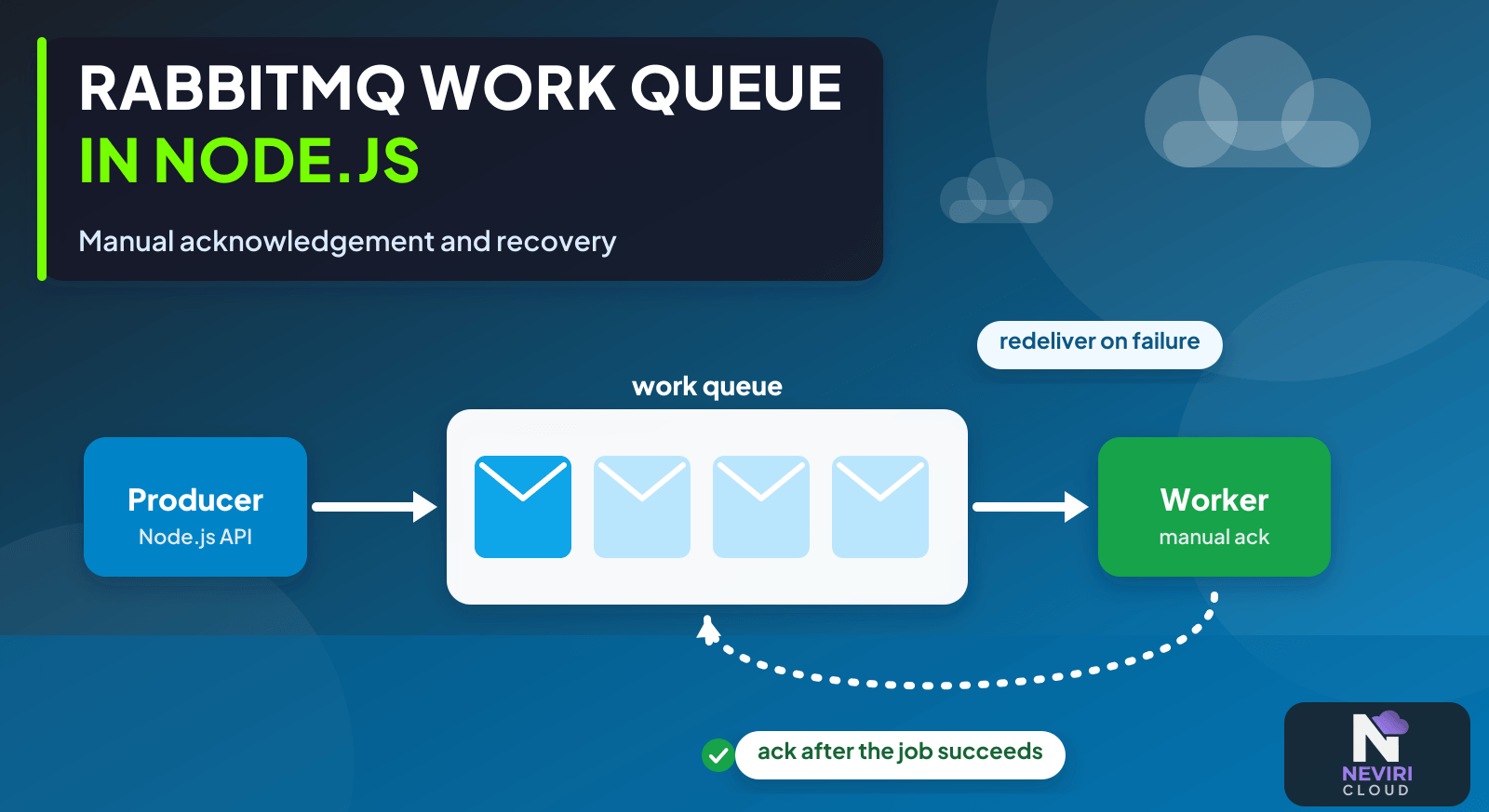
A queue can get a slow task out of an HTTP request, but it introduces another question: when is that task really finished? If a worker disappears at the wrong moment, RabbitMQ may deliver the job again. Let’s build the Node.js worker around that possibility instead of assuming the happy path will cover it.
Have the worker acknowledge a job after the required work commits, and make that work safe to receive again. Keep concurrency and retries bounded. Before using the queue for customer-facing tasks, stop a worker midway through a job and check what happens when RabbitMQ delivers it again.
Build a worker that can recover
- Give the operation a stable business identifier before publishing and define the durable acceptance boundary.
- Use the client library and broker settings appropriate to your version; do not confuse publishing with a publisher confirmation.
- Process with bounded concurrency and acknowledge after committing the required business effect.
- Interrupt a worker in a test environment, inspect redelivery, and verify that retry does not duplicate the effect.
Choose how the worker handles delivery
| Approach | Choose it when | Verification or tradeoff |
|---|---|---|
| Synchronous request | The work is short and the result is immediately needed | Use bounded request timeouts. |
| RabbitMQ work queue | Independent workers must process durable asynchronous jobs | Own job state and duplicate handling. |
| Database-backed jobs | A modest workload can share an existing database | Evaluate contention and worker recovery. |
A small example to try
// conn is an established amqplib connection.
// commitJobOnce must atomically protect the business effect by job.id.
export async function startWorker(conn, commitJobOnce) {
  const ch = await conn.createChannel();
  await ch.assertQueue('jobs', { durable: true });
  await ch.prefetch(1);
  await ch.consume('jobs', async (msg) => {
    if (!msg) return;
    try {
      const job = JSON.parse(msg.content.toString());
      if (!job.id) throw new Error('Missing operation identifier');
      await commitJobOnce(job.id, job);
      ch.ack(msg);
    } catch {
      // Requires a configured, tested dead-letter route for failed jobs.
      ch.nack(msg, false, false);
    }
  }, { noAck: false });
  return ch;
}
This consumer skeleton separates acknowledgement from the business commit. Your app supplies the durable commitJobOnce implementation; the example does not manufacture exactly-once behaviour. Before using rejection without requeue, configure and test the dead-letter route. Without an appropriate dead-letter configuration, rejected work can be discarded rather than retained for investigation. Production connection recovery, shutdown, bounded retries, and publisher confirms need their own supported implementation. amqplib channel API.
What does accepting a job mean to the API caller?
Define acceptance before connecting the HTTP handler to RabbitMQ. A successful response should correspond to a durable record or broker acceptance boundary that your application actually relies on. If publishing fails, the caller needs an explicit outcome; a log message printed after returning success cannot serve as the job's only recovery record.
Return a stable operation identity when work continues after the request. The identity should let the user retrieve status or correlate a later notification. It also gives the system a way to reconcile a caller retry without unintentionally creating a second business job. A broker delivery tag serves another purpose and should not be exposed as the permanent job identity.
Decide what the caller sees when the final result is uncertain. For example, a disconnected request may have been accepted before its response was lost. The retry contract should let the client ask about the original operation, not force it to choose between abandoning the task and creating a possible duplicate.
How do publisher confirmation and job status fit together?
A publisher confirmation concerns broker handling of a publish; it does not say that a worker completed the job. Keep broker acceptance and application completion as different observations. A job can be accepted and then wait while workers are unavailable, or it can reach a worker and fail permanently because its input is invalid.
If creating a database record and publishing a message are separate operations, examine the failure between them. A database row can exist without a corresponding message, or a message can exist when your app did not retain the status it intended. Choose a reconciliation or transactional-outbox pattern appropriate to the workload instead of pretending two independent successful calls are one atomic action.
This does not require every prototype to adopt a large orchestration framework. It does require a visible account of what can become inconsistent and who repairs it. A small, inspectable recovery process can be more useful than a complex system whose failure boundaries nobody has rehearsed.
Which worker interruptions should the test cover?
| Interruption point | What may have happened | Verification question |
|---|---|---|
| Before delivery | The broker has accepted work but no consumer has processed it | Does the job remain discoverable and eventually reach an available consumer? |
| After delivery, before business work | A consumer owns an unacknowledged delivery | Does interruption make that work recoverable under the configured acknowledgement mode? |
| After the business commit, before acknowledgement | The effect exists while the broker may redeliver | Does the stable job identity prevent an incorrect repeated effect? |
| After acknowledgement | The delivery boundary is complete | Can the caller still discover your app's durable completion result? |
| During a retry transition | The previous attempt failed or is ambiguous | Are the original identity and attempt history preserved? |
Run these interruptions against an isolated example job whose effect is easy to inspect. Do not use a real payment or customer email to discover whether duplicate protection works. Compare the business result with the job record and broker observations, rather than relying on one counter in a dashboard.
How do you choose concurrency without flooding the database?
Treat every worker as a consumer of more than CPU. It may hold database connections, memory for a payload, and capacity on an external API. Increasing consumers can therefore reduce reliability if all of them compete for a dependency already at its limit.
Begin with a bounded number of in-flight jobs and observe completion time, failures, and the age of pending work. Increase the bound only when the next limiting resource is understood. Prefetch is one part of this design; it does not independently cap every asynchronous task your app might start after delivery.
If jobs have very different costs, check whether a small number of slow jobs can monopolize consumers while short jobs wait. Separate routing or worker groups may be appropriate when the business priorities justify them. Keep the justification tied to observed workload behaviour rather than splitting queues merely to make a diagram look more sophisticated.
What does a safe first recovery procedure look like?
Keep a note of a safe failure category, the operation identity, the last attempt time, and whether a business effect might already exist. The person replaying a job should not need to reconstruct those facts from unrelated application logs. Protect payload access because job data can be as sensitive as the underlying database records.
Before replaying, fix or classify the cause. A malformed payload does not become valid after another thousand attempts. A temporary unavailable service may recover, but it still needs a retry budget and an eventual terminal state. After replay, verify the effect and the resulting job status, then inspect whether the same failure repeats.
The RabbitMQ JavaScript work-queue tutorial is the primary reference for the broker-side starting pattern. The amqplib API defines client calls used in the skeleton. Your app-specific acceptance record, idempotency boundary, and recovery procedure remain part of the system you build around those APIs.
What should happen to in-flight jobs during worker shutdown?
Stop taking new work through the client's supported consumer lifecycle before waiting for the work already accepted by the process. Give that wait an explicit bound and define what happens when the bound is reached. Do not mark unfinished jobs complete merely to make shutdown appear orderly.
Keep the acknowledgement context associated with each delivery while it is processed. If the channel closes, your app should follow the documented recovery path rather than acknowledging an old delivery through a newly opened channel. The business operation's stable identity should remain useful even when its broker delivery changes.
Test shutdown with a slow job and a job near its business commit. Compare the durable result and pending work after replacement. This is the release-time version of the same interruption boundary the queue must handle during a crash.
A worker can stop after doing the work
A work queue moves slow processing out of the HTTP request, but it creates a second lifecycle to manage. The user needs a reliable acceptance result and a way to distinguish pending, completed, and failed work. RabbitMQ’s JavaScript tutorial provides a starting point; business idempotency and recovery need application-specific design.
Questions you might have
When should the worker acknowledge?
Acknowledge after the required business operation has committed successfully. If the worker acknowledges before that point and then fails, the job may be lost. If it commits and loses the acknowledgement, redelivery is possible, so the same operation identifier must prevent an incorrect duplicate business effect.
Does a durable queue guarantee my job completed?
Queue durability does not prove a consumer completed the business operation. Publisher acceptance, stored messages, delivery, and application commit are different milestones. Select the required broker durability and publisher-confirm behaviour, then track job completion in your app and verify the failure cases relevant to the workload.
How should I choose prefetch?
Choose prefetch from measured job duration, memory use, and downstream capacity. Begin with a bounded value appropriate to the worker and observe throughput and fairness. Increasing in-flight deliveries can overload a database or delay redistribution when a worker fails, so test interruptions as well as maximum successful throughput.
Keep reading
Separate Background Workers from Your Web Application; Container Health Check on the Wrong Port: Diagnose Failed Deployments; A Production Readiness Checklist for Your First SaaS Application; PostgreSQL Connection Pooling: Prevent Connection Exhaustion; RabbitMQ Reliability: Acknowledgements, Retries, and Duplicate Messages; RabbitMQ Dead-Letter Queues: Handle Failed Jobs Without Losing Visibility.
Try the failure before it matters
Before you trust the worker with important jobs, interrupt it between delivery and completion. Watch what comes back, and check whether the business action happens again. That small rehearsal tells you more about recovery than a screen full of successful jobs, because it reaches the point where acknowledgement and application work can come apart.
Sources and further reading
RabbitMQ distinguishes consumer acknowledgements from publisher confirms; each covers a different end of the delivery path. RabbitMQ documentation.
Tools and patterns for running background tasks. describes a related situation: A Next.js developer describes a project stalled by the need to process many background jobs continuously.